15 April 2026
I've been AI pilled
First published on LinkedIn, 3 March 2026.
I started using Claude Code a week ago and it feels like I’ve crossed the rubicon.
I’d been hearing that these tools were getting exceptionally good. I was sceptical. I thought, as many do, “I’ve used AI, it’s handy for writing emails and such, but beyond that it’s not great”. I’d seen ChatGPT botch basic calculations. I’d seen Copilot struggle to build a simple PowerPoint. “Sure it’s coming, but it’s not useful for anything I do today”.
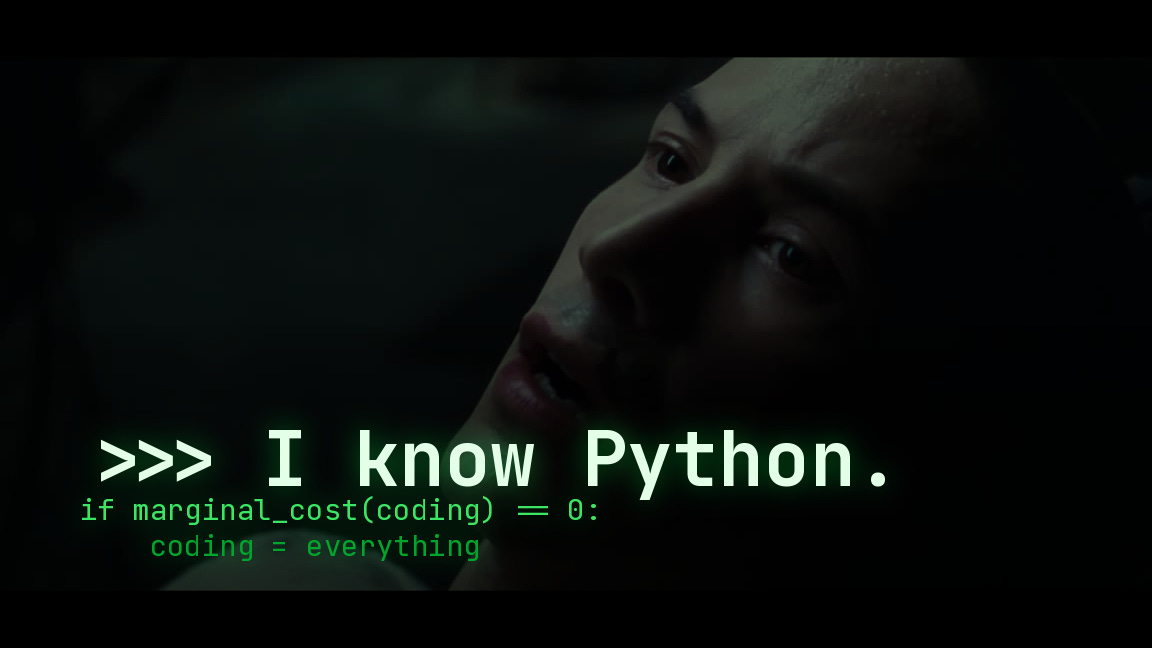
Boy, was that naive. After a week with Claude I’ve realised it’s useful for nearly everything I do. And what I hadn’t grasped until using the coding module is this: when the marginal cost of writing code approaches zero, almost every problem has a coding solution. Or at the very least, almost every problem has parts that can be written as a computer program.
I’m no software engineer. I never have been. A few years ago I completed most of Harvard’s CS50x online (an excellent university-level introduction to computer science) but never quite finished it. I’d played around with coding over the years but nothing stuck and it never became part of my regular workflow. Now, though, I know just enough to be dangerous with Claude Code. And I mean that literally. I could genuinely mess up my Mac if I’m not careful.
I started with Claude in the chat module. I used it to build structured prompts and workflows for investment research. Software stocks were tanking and I thought it might be interesting to dig into a few ideas and see what the fuss was about with Claude. I was genuinely impressed. Anything I’d done with ChatGPT was child’s play compared to the 20–30 page reports I could now produce, tailored to my investment thesis, with deep analysis of competitive moats, bull/bear cases, valuation, and market sentiment. Not AI slop. Genuine structured insight.
Then I heard that bpost (Belgian post) was thinking about how to expand their parcel box network, reaching the most people within five minutes’ travel time with the fewest boxes possible. I thought it could be an interesting test case to take off the training wheels and try Claude Code. This was the use case that opened my eyes to the possibilities.
After some back and forth defining requirements, I set Claude to work collecting and analysing data. It searched online (with very little guidance from me) for open data sources on population distribution, mapping tools, points of interest, and existing parcel box locations. It came up with ideas and processes I hadn’t even considered. It set up and ran a Python script over the data using a greedy maximal coverage location algorithm (I only sort of know what that means) to identify coordinates that would maximise population coverage with the minimum number of boxes.
Within 18 hours, of which I was at my computer for maybe three, I had a working web app visualising the optimal distribution, with tools to adjust input parameters. I’m fairly confident I could do it in under an hour of my actual time if I did it again. And my next version is going to be even better. With Claude, I’m building a machine learning model that identifies where bpost lockers are today based on population, demographics, maps, planning and zoning data, and predicts good locations for a new box. This could easily be supplemented with real world data on current box performance to identify not just where they are today, but where they should be. With more experience, this is easily a one workday project, run in parallel with four or five other tasks like it.
> When the marginal cost of coding is zero, everything becomes a coding problem_AI is not going to change the world. It has changed the world. On 5 February, when Anthropic and OpenAI shipped Opus 4.6 and GPT-5.3 Codex within minutes of each other, we didn’t just get access to new models. We got access to everything. Anyone can now deploy some of the most sophisticated computer and data science technology from their phone while waiting for the bus.
So am I a doomer? Oddly, no. I have more optimism than I did before. I’m starting to see how the work humans do will expand to fill the time allowed. I’m thinking about all the optimisation problems that never get solved because they simply aren’t worth the time. Until now.
It’s often said that the future is here, it’s just not evenly distributed. Look at how companies actually work and you see massive variations in efficiency. A good deal of this is technical debt and complexity that has built up over decades. Just ask anyone who has tried to replace a 20-year-old ERP (enterprise resource planning) system.
People talk about AI creating new technological breakthroughs. That will happen. But I’m equally interested in how it can make the technology we already have better distributed. And when technology becomes better distributed, so too will technologists. I can already picture early-career software engineers being redistributed across the economy. As people like me start to vibecode up all manner of weird and wonderful things, companies will need people to oversee what’s being built and put proper safeguards in place.